Matchup Overview & Context
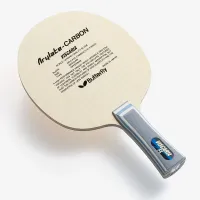
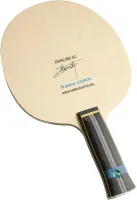
Butterfly Viscaria and Butterfly Viscaria Super ALC are high-end offensive blades built with a 5+2 wood and carbon construction featuring outer placement of the composite layer. Sitting in the ~€160 and ~€204 price tiers respectively, players frequently compare them because the Super ALC is marketed as an evolution of the legendary classic Viscaria. The standard Viscaria is globally renowned for its balanced, forgiving feel and exceptional looping consistency, whereas the Super ALC targets players looking for a crisper response and enhanced energy transfer without abandoning the core geometry of the Viscaria handle and overall design.
Weight & Bounce Frequency
The standard Viscaria has a manufacturer stated weight of 90g with measured samples averaging around 88g, paired with a tap-test bounce frequency of 1455 Hz. The Viscaria Super ALC measured samples weigh slightly heavier at 91g to 93g, registering a higher tap-test frequency of 1500 Hz. This measurable increase in vibration frequency reflects the tighter, denser weave of the Super Arylate-Carbon material, which yields a higher structural stiffness.
Speed, Feel & Dwell Time
Community feedback highlights a distinct divergence in feel between the two models. The classic Viscaria provides a notably softer, more flexible sensation on impact, allowing the ball to sink into the wood for a generous dwell time and reliable linear feedback. In contrast, reviewers describe the Viscaria Super ALC as noticeably stiffer, crisper, and harder. The Super ALC reduces dwell time in favor of a flatter, more penetrating throw angle and instantaneous energy return, though some users debate whether this makes it less forgiving on passive strokes.
Stroke-by-Stroke Consensus
- Short Game & Touch: The standard Viscaria offers superior touch and forgiveness on passive pushes and service returns due to its softer flex. The Super ALC requires a more precise touch because its stiffer rebound can cause the ball to pop up if the blade angle is not strictly controlled.
- Looping & Topspin: The classic Viscaria rewards active loopers with a high, reliable arc and effortless topspin generation. The Super ALC produces a lower throw angle with rapid acceleration, making opening loops punchy and direct, though it demands better footwork to maintain consistency.
- Blocking & Smashing: The Super ALC shines in active blocking and flat hitting, utilizing its rigidity to deflect heavy incoming power with minimal energy loss. The standard Viscaria is also praised for reliable blocking, offering a more cushioned feel that absorbs opponent pace effectively.
- Counter-Play & Mid-Distance: Away from the table, the Super ALC provides exceptional stability and power reserves, allowing counter-loops to penetrate effortlessly. The standard Viscaria relies more on player mechanics and flexibility to generate mid-distance depth, though it remains a trusted benchmark for counter-looping.
Recommended Rubber Pairings
Both blades pair exceptionally well with modern offensive rubbers, but their differing stiffness alters the synergy. For the classic Viscaria, medium-hard to hard European tensors like Tibhar Evolution MX-P or high-end Japanese/German factory-tuned sheets complement the blade's natural flexibility, while tacky or high-density rubbers like Dignics 09C or Tenergy 05 offer elite looping precision. For the Viscaria Super ALC, players often prefer slightly more controllable or linear rubbers like Nittaku Fastarc G1 or spin-elastic tensors to harness the blade's inherent speed without sacrificing all safety margins on passive blocks.
Target Player & Playstyle
Classic Viscaria: Suited for all-round offensive loopers, intermediate to professional players who rely on controlled topspin rallies, and those who prefer a softer, more communicative wood feel with reliable flexibility.
Viscaria Super ALC: Suited for advanced, highly active attackers with sound footwork who demand a stiffer, faster trajectory, flatter arc, and maximum power for direct point-ending shots.
Verdict & Buying Guidance
Butterfly Viscaria Pros:
- Legendary, highly predictable feel with excellent flexibility
- Forgiving dwell time enhances looping consistency
- Comfortable handle geometry and reliable passive control
- Pairs easily with a wide spectrum of offensive rubbers
Butterfly Viscaria Cons:
- Can feel too soft for players who prefer a direct, rigid carbon hit
- Price has increased significantly over recent years
Butterfly Viscaria Super ALC Pros:
- Noticeably faster and stiffer energy transfer
- Exceptional stability and penetrating power away from the table
- Crisp feedback for aggressive flat hits and active blocks
- High structural rigidity for quick transitions
Butterfly Viscaria Super ALC Cons:
- Lower throw angle can reduce margin for error on soft loops
- Demands high technical level and precise footwork
- Premium price tier compared to the standard model
Choose the Butterfly Viscaria if you prioritize a softer, more flexible feel, higher looping arc, and forgiving dwell time.
Choose the Butterfly Viscaria Super ALC if you want maximum rigidity, a flatter trajectory, and extra speed for an aggressive, power-driven attack.