Matchup Overview & Context
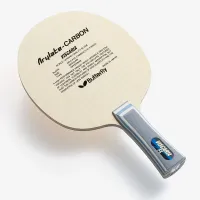
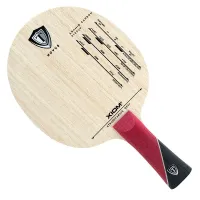
Both the Butterfly Viscaria and the Xiom Stradivarius feature a classic 5+2 outer composite construction, pairing outer wood plies with synthetic carbon fibers—specifically Arylate-Carbon. They are designed for modern offensive players who rely on topspin and active counter-looping. The Viscaria is an industry standard and a benchmark for professional performance, sitting in the ~€163.85 price tier. The Xiom Stradivarius is frequently cited as a high-value alternative offering comparable performance at a budget-friendly ~€94.32 price tier. Players often compare them when looking for an outer-carbon blade that balances speed with controllable touch.
Weight & Bounce Frequency
Manufacturer stated weights are 90g for the Viscaria and 87g for the Stradivarius (measured via TT11). In actual samples, the Viscaria weighed in at 88g, while the Stradivarius weighed 83g, though user feedback notes variations up to 89g depending on the specific specimen. Tap-test bounce frequency measurements show the Stradivarius vibrating at 1583 Hz, noticeably higher than the Viscaria at 1455 Hz. This higher frequency indicates a stiffer structural baseline and a higher pitch for the Stradivarius, whereas the Viscaria absorbs impact slightly more to produce a more forgiving, flexible response.
Speed, Feel & Dwell Time
Reviewers consistently describe the Viscaria as having a surprisingly soft, flexible feel for a carbon blade, allowing for deep ball penetration and a longer dwell time before it unleashes explosive power. Reviewers characterize the Stradivarius as noticeably stiffer and harder, featuring a shorter dwell time and minimal blade-base vibration. While some players praise the Stradivarius for its crisp, direct feedback and distinctive clicking sound on topspin, others note that it can feel somewhat rigid or devoid of tactile feedback compared to the Viscaria. The Viscaria rewards active play with great consistency, whereas the Stradivarius delivers a direct, linear energy transfer.
Stroke-by-Stroke Consensus
- Short Game & Touch: The Viscaria offers exceptional control on pushes, drop shots, and service returns due to its longer dwell time and flex. The Stradivarius is reliable in the short game, but its stiffer nature requires a more precise touch to keep low-arc pushes short.
- Looping & Topspin: The Viscaria excels at producing a high, forgiving arc with deep spin generation on opening loops. The Stradivarius produces a flatter trajectory with a lower, more direct arc, favoring aggressive, direct drives and fast follow-up kills rather than heavy, looping rallies.
- Blocking & Smashing: The Viscaria provides effortless passive and active blocking thanks to its stable sweet spot. The Stradivarius shines particularly bright in blocking and flat hitting, offering a rock-solid platform that redirects opponent energy with minimal effort.
- Counter-Play & Mid-Distance: Away from the table, the Viscaria maintains its acceleration and energy well into deep mid-distance rallies. The Stradivarius performs capably in the early zones of a rally, but some users note that its effectiveness tends to taper off during extended, ultra-deep counter-looping exchanges.
Recommended Rubber Pairings
For the Butterfly Viscaria, players widely recommend medium-hard to hard European tensors or high-end tacky rubbers such as Tibhar Evolution MX-P Max or Butterfly Tenergy and Dignics series (05, 80, 09C). These pair well with its flexible core to amplify spin without sacrificing control. For the Xiom Stradivarius, because of its stiffer and harder nature, medium to medium-soft rubbers are heavily favored. Players recommend Xiom Vega Europe or Rakza 7 Soft to add much-needed dwell time, while avoiding overly hard or tacky Chinese rubbers that can render the setup unplayably dead.
Target Player & Playstyle
- Butterfly Viscaria: Suited for advanced to professional-level two-winged loopers who demand high flexibility, an accommodating arc, and rich tactile feedback for dynamic mid-distance rallies.
- Xiom Stradivarius: Suited for intermediate to advanced offensive players who prefer a direct, crisp, and stiff carbon blade optimized for flat hits, counter-attacks, and aggressive blocking close to the table.
Verdict & Buying Guidance
- Butterfly Viscaria Pros: Legendary consistency, forgiving flex, exceptional dwell time, and excellent resale value.
- Butterfly Viscaria Cons: Premium price tag and can feel too soft for players who prefer rigid, uncompromising speed.
- Xiom Stradivarius Pros: Outstanding price-to-performance ratio, exceptional stability in blocking, and crisp direct power.
- Xiom Stradivarius Cons: Stiffer feel with less tactile feedback, shorter dwell time requiring cleaner technique, and potential handle discomfort for certain grip styles.
- Choose the Butterfly Viscaria if you want a proven tournament benchmark with high flexibility, long dwell time, and superior feel for looping.
- Choose the Xiom Stradivarius if you want a budget-friendly outer carbon blade that rewards a direct, flat-hitting and aggressive blocking style.