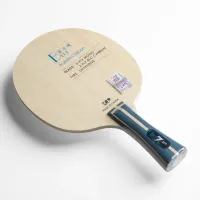
Matchup Overview & Context
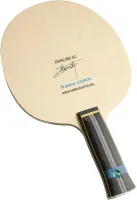
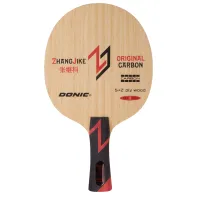
Both blades represent premium 5+2 composite constructions featuring outer arylate-carbon fiber layers, sharing a general architectural lineage with legendary OFF-class blades like the Viscaria. The Butterfly Zhang Jike ALC is priced around ~€160, though increasingly scarce due to production status, while the Donic Zhang Jike Original Carbon retails around ~€145. Players frequently compare these two because they target offensive loopers and all-round attackers who demand elite carbon performance without stepping up to wild, unmanageable speeds.
Weight & Bounce Frequency
The Butterfly Zhang Jike ALC has a manufacturer stated weight of 86g with measured sample weights averaging around 88g (and community samples reaching 92g). Its tap-test bounce frequency sits at a moderate 1436 Hz, reflecting its more flexible core. In contrast, the Donic Zhang Jike Original Carbon features a measured sample weight of 85g, paired with a much higher tap-test bounce frequency of 1580 Hz. This indicates that despite similar static weights, the Donic blade is significantly stiffer and holds a sharper, faster acoustic resonance.
Speed, Feel & Dwell Time
Community reviews highlight a stark contrast in feel between the two. The Butterfly offers a softer touch, pronounced dwell time, and a medium-high throw angle, giving players immense confidence to accelerate through the ball. Reviewers praise its tactile feedback and forgiveness. Conversely, the Donic is characterized as noticeably faster, stiffer, and crisper with virtually zero vibration. While some users find the Donic slightly stiff initially, they note it yields explosive linear speed and a very wide sweet spot, though a few point out a smaller effective sweet spot on hard impacts compared to traditional alternatives.
Stroke-by-Stroke Consensus
- Short Game & Touch: The Butterfly excels in passive pushes, short touch play, and service returns due to its superior dwell time and feedback. The Donic offers reliable control in the short game as well, but requires a more precise touch because of its stiffer, faster rebound.
- Looping & Topspin: The Butterfly behaves as a spin monster, creating a generous medium-high arc that makes opening loops effortless. The Donic shines on first attacks—especially on the backhand wing—delivering piercing speed and heavy spin when accelerated properly.
- Blocking & Smashing: The Donic stands out for active and passive blocking, as its stiff carbon layer absorbs incoming power and redirects it with flat, crisp trajectory. The Butterfly offers great stability too, though it relies more on wood flex than pure carbon stiffness.
- Counter-Play & Mid-Distance: Both blades offer elite stability away from the table. The Butterfly allows for deep, looping rallies with a forgiving margin of error, while the Donic maintains lightning-fast counter-looping capabilities without bottoming out.
Recommended Rubber Pairings
The Butterfly Zhang Jike ALC pairs exceptionally well with spin-elastic tensors like Tenergy 80-FX or medium-hard European rubbers (such as Nittaku G1 or Xiom Vega Pro), which complement its softer touch and enhance dwell time. The Donic Zhang Jike Original Carbon pairs brilliantly with ultra-hard, modern tacky hybrids or premium tensor rubbers like Dignics 05 or Tibhar Hybrid K3. The rigidity and high frequency of the Donic blade tame the extreme tackiness and speed of these rubbers, providing a direct, authoritative trajectory.
Target Player & Playstyle
This matchup suits offensive-minded players of advanced levels, but with divergent mechanical preferences. The Butterfly Zhang Jike ALC suits modern loopers who value touch, flexible pacing, and looping consistency from mid-distance. The Donic Zhang Jike Original Carbon suits fast-attackers, active blockers, and close-to-the-table counter-drivers who demand crisp feedback, rapid energy transfer, and a stiffer structural response.
Verdict & Buying Guidance
- Butterfly Zhang Jike ALC Pros: Softer touch, generous dwell time, high margin of error on loops, excellent tactile feedback.
- Butterfly Zhang Jike ALC Cons: Lower top-end speed than extreme carbon variants, rising secondary market scarcity, potential lack of stiffness for pure hitters.
- Donic Zhang Jike Original Carbon Pros: Exceptional raw speed, crisp and vibration-free feedback, phenomenal backhand first-attack capability, great serve spin generation.
- Donic Zhang Jike Original Carbon Cons: Stiffer initial feel requires adaptation, potentially smaller sweet spot on extreme off-center hits.
Choose the Butterfly Zhang Jike ALC if you prioritize a softer touch, longer dwell time, and a higher loop trajectory for a dynamic, spin-oriented offensive game.
Choose the Donic Zhang Jike Original Carbon if you want a stiffer, significantly faster blade with crisp feedback, minimal vibration, and maximum efficacy in fast counter-attacking and direct blocking.