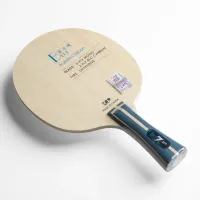
Matchup Overview & Context
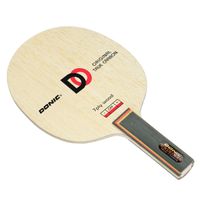
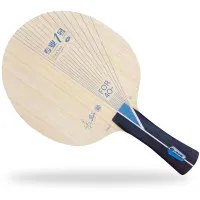
Both blades belong to the popular outer-composite category patterned after the classic Viscaria design, utilizing synthetic fibers placed directly beneath the outer plies. The Donic Original True Carbon retails around ~€108, positioning itself as a mid-tier offensive blade from a recognized European brand. Meanwhile, the Yinhe Pro 01 retails around ~€74, delivering exceptional budget-friendly performance that challenges high-end blades. Players frequently compare these two because both serve as viable, cost-effective substitutes for premium carbon blades while offering distinct mechanical variations in stiffness and feedback.
Weight & Bounce Frequency
Both models share a manufacturer stated weight of 90 grams. The Yinhe Pro 01 measured sample hits the 90-gram mark precisely, though individual samples can drift higher depending on regional inventory. The Yinhe features a tap-test bounce frequency of 1425 Hz, reflecting a rigid core structure. While Donic does not publish an exact tap frequency, community feedback indicates the Donic feels slightly more flexible and forgiving during impact compared to the rigid nature of the Yinhe.
Speed, Feel & Dwell Time
Reviewers are divided on how these blades compare to high-end benchmarks. The Donic Original True Carbon is described by some as identical in speed to a standard Viscaria, while others find it faster yet slightly softer in overall feedback, granting a more welcoming dwell time for topspin mechanics. The Yinhe Pro 01 splits opinion sharply: some users experience it as a softer, slightly hollow alternative to premium Butterfly blades, while others note it is noticeably stiffer and less flexible than a standard Viscaria. Consequently, the Yinhe provides a crisper, more direct transfer of energy at the cost of a slightly reduced dwell time.
Stroke-by-Stroke Consensus
- Short Game & Touch: The Donic offers reliable touch play and controlled pushes due to its slightly softer outer composition. The Yinhe requires a delicate touch; its stiffer response makes short pushes manageable, but less forgiving on passive reception.
- Looping & Topspin: The Donic yields a generous arc and comfortable dwell time, favoring modern European looping styles. The Yinhe demands precise timing and technique on the forehand loop, but rewards the player with lethal, penetrating power once mastered.
- Blocking & Smashing: The Yinhe shines in active and passive blocking due to its lateral stiffness, absorbing incoming power cleanly. The Donic is equally capable in offense, though it relies more on flex than sheer rigidity to redirect energy.
- Counter-Play & Mid-Distance: The Yinhe excels significantly in counter-topspin exchanges, allowing players to redirect fast balls simply by meeting the incoming trajectory. The Donic retains stability away from the table, though power scaling requires active physical engagement.
Recommended Rubber Pairings
For the Donic Original True Carbon, classic spin-elastic European tensors pair wonderfully, capitalizing on the blade's natural flex to maximize dwell time and launch angle. For the Yinhe Pro 01, community consensus strongly favors hard-sponge tacky rubbers, particularly when boosted. Reviewers note that traditional tensors can feel erratic on the stiffer Yinhe, whereas dense, tacky Chinese rubbers tame the rigid trajectory and unlock maximum spin potential during counter-attacks.
Target Player & Playstyle
- Donic Original True Carbon: Suited for modern offensive loopers and mid-distance attackers who prefer a slightly softer feel, comfortable handle ergonomics, and dependable feedback during spin-oriented rallies.
- Yinhe Pro 01: Tailored for intermediate to advanced backhand-oriented players, counter-drivers, and budget-conscious competitors who prefer a stiffer, linear response and a top-heavy weight distribution for aggressive blocking.
Verdict & Buying Guidance
- Donic Original True Carbon Pros: Comfortable smaller handle, softer feedback than standard carbon blades, excellent balance for versatile offensive play.
- Donic Original True Carbon Cons: Higher price point than budget Chinese alternatives, limited vibration feedback for traditionalists.
- Yinhe Pro 01 Pros: Exceptional build quality for the price, superb counter-looping stability, highly durable finish.
- Yinhe Pro 01 Cons: Top-heavy weight distribution, thin upper handle ergonomics, less forgiving for players lacking polished timing.
Choose the Donic Original True Carbon if you want a softer, more flexible offensive blade with great dwell time that mirrors a premium European setup.
Choose the Yinhe Pro 01 if you prioritize a stiff, direct response, exceptional counter-attacking stability, and maximum performance per dollar.