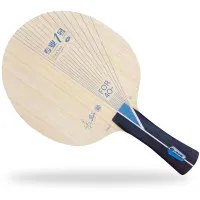
Matchup Overview & Context
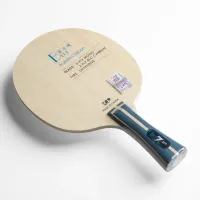
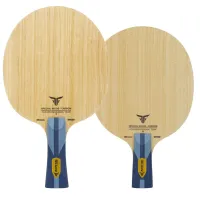
Both the Friendship/729 Blue ALC and the Loki Telson Speed are budget-oriented table tennis blades utilizing an outer Arylate-Carbon (ALC) construction, mirroring the legendary Viscaria blueprint with a Koto outer ply. Players typically compare these models when searching for high-performance composite characteristics without paying premium brand prices. The Friendship/729 Blue ALC sits in an extremely affordable price tier around ~€22, while offering accessible offensive capabilities. Detailed community data and measured metrics are widely documented for the 729 Blue ALC, whereas the Loki Telson Speed serves as a lesser-known alternative in the budget composite category.
Weight & Bounce Frequency
Manufacturer stated weight for the Friendship/729 Blue ALC is 85 grams, though real-world samples typically range from 86 to 95 grams, occasionally feeling head-heavy depending on the specific copy. Tap-test measurements for the 729 Blue ALC show bounce frequencies generally clustering between 1370 Hz and 1500 Hz, reflecting a medium-stiff offensive profile with a noticeable sweet spot expansion provided by the carbon layers. Sample variations require players to check exact weights if they prefer a lighter setup.
Speed, Feel & Dwell Time
Reviewers describe the Friendship/729 Blue ALC as an offensive blade that prioritizes control and loop-drive consistency over raw, unbridled speed. Unlike ultra-stiff carbon blades, it retains a surprising degree of flex and a softer touch reminiscent of all-wood constructions, allowing the ball to dwell on the surface for deep spin generation. While some users praise its controllable arc and feedback, others note that it can lack finishing power when played deep in the third zone or when executing flat kills out of position.
Stroke-by-Stroke Consensus
Short Game & Touch: The flexible outer-ply construction allows for precise, low pushes and controlled service returns, though unvarnished edges may require minor sanding for comfort.
Looping & Topspin: Acting as a true looping machine, it generates a long, safe trajectory and heavy rotation, preventing the ball from flying long during aggressive topspin rallies.
Blocking & Smashing: Passive and active blocks remain stable due to the enlarged sweet spot, but flat-out smashing lacks the absolute put-away lethality found in stiffer, harder carbon blades.
Counter-Play & Mid-Distance: Performs admirably in the first and second zones for counter-looping, but experiences a drop-off in power and stability when pushed back to the far mid-distance.
Recommended Rubber Pairings
To maximize the 729 Blue ALC, medium-hard to hard Chinese tacky rubbers (such as 40-degree or 46-degree variants) paired with modern spin-elastic tensors create a balanced offensive weapon. The blade's inherent dwell time complements tacky forehand sheets by supporting deep, spin-heavy strokes, while backhand tensors add crispness for quick redirection.
Target Player & Playstyle
This matchup targets intermediate to advanced offensive players who rely heavily on topspin and looping rather than flat hitting. It suits budget-conscious competitors transitioning from pure wood to composite blades who desire carbon stability without sacrificing tactile feedback and dwell time.
Verdict & Buying Guidance
Pros of the Friendship/729 Blue ALC:
- Exceptional value for an outer-ALC composite blade
- Generous sweet spot and long, controllable arc
- Wood-like touch and dwell time that favors heavy looping
Cons of the Friendship/729 Blue ALC:
- Inconsistent factory weight distribution across samples
- Lacks power during deep mid-distance rallies and flat smashes
- Limited handle options (only flared available, requiring manual modification for straight-handle fans)
Choose the Friendship/729 Blue ALC if you want an inexpensive, loop-friendly outer-ALC blade that bridges the gap between pure wood feel and carbon stability.
Choose the Loki Telson Speed if you prefer to experiment with lesser-known budget alternatives sharing a similar structural philosophy.