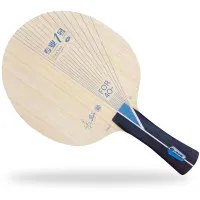
Matchup Overview & Context
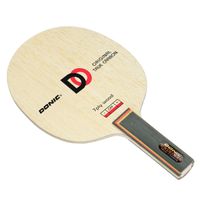
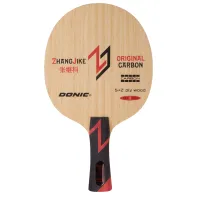
Both the Donic Original True Carbon and the Friendship/729 Blue ALC belong to the highly popular outer Arylate-Carbon (5+2 construction) category, sharing a structural lineage similar to legendary blades like the Butterfly Viscaria. The Donic Original True Carbon retails around ~€108, positioning itself as a cost-effective, high-performance alternative to premium Japanese and European blades for modern offensive players. On the other end, the Friendship/729 Blue ALC acts as an extreme budget contender priced around €22, drawing immense interest from players looking to experiment with carbon-reinforced blades without financial risk. While both cater to topspin-oriented attackers, they differ significantly in raw power output, manufacturing consistency, and flex.
Weight & Bounce Frequency
The manufacturer stated weight for the Donic Original True Carbon is 90 grams with a thickness of 6.2 mm, lending it a solid, substantial feel in hand. The Friendship/729 Blue ALC carries a manufacturer stated weight of 85 grams, though real-world samples widely vary from 86 to 95 grams with a noticeable head-heavy balance and a thinner profile ranging from 5.6 to 5.9 mm. Community testing on the 729 Blue ALC reveals tap-test bounce frequencies between 1445 Hz and 1500 Hz, reflecting a relatively flexible baseline for a composite blade that retains decent vibration and a traditional pure-wood sensation.
Speed, Feel & Dwell Time
Player opinions highlight a clear contrast in feedback and dynamics. The Donic Original True Carbon is widely described as matching or exceeding the speed of premium benchmark blades, featuring a crisp yet slightly softer impact feeling than a standard Viscaria with a reliable carbon sweet spot. Conversely, reviewers describe the 729 Blue ALC as possessing a more prominent flex, lower stiffness, and a softer touch that elongates dwell time. While some users praise the 729 for its forgiving nature and looping-friendly arc, others note that it can lack punch and stability when retreating far away from the table or executing flat-hitting strokes.
Stroke-by-Stroke Consensus
Short Game & Touch: The Donic offers a precise, direct platform for aggressive pushing and quick service returns, though its stiffness demands a steady hand. The 729 Blue ALC provides exceptional dwell time for short touches and gentle pushes, allowing players to impart heavy underspin with high security.
Looping & Topspin: Donic excels at fast, penetrating opening loops and mid-distance counter-attacks with a flat, driving trajectory. The 729 acts as a true looping machine close to the table, generating a long, high arc that dips reliably onto the opponent's side, though it requires active body rotation to avoid under-powering.
Blocking & Smashing: Active and passive blocking are crisp and stable on the Donic due to its rigid outer plies. The 729 handles controlled redirection well, but its flexibility can cause instability during flat-out smashes or when caught out of position against high-speed drives.
Counter-Play & Mid-Distance: The Donic retains high energy transfer and linear speed well into the second and third zones. The 729 tends to drop off in power when played deep away from the table, relying heavily on rubber synergy to maintain depth at long distances.
Recommended Rubber Pairings
For the Donic Original True Carbon, hard-sponge tacky Chinese rubbers or high-tension dynamic tensors on the forehand pair exceptionally well, capitalizing on the blade's rigid carbon core to generate explosive put-away power. For the Friendship/729 Blue ALC, medium-hard to hard European tensors or hybrid rubbers (such as 46-degree sponges or tacky provincial rubbers) complement its flexible nature, boosting the overall energy ceiling while preserving the blade's inherent spin-friendly dwell time.
Target Player & Playstyle
Donic Original True Carbon: Suited for intermediate to advanced offensive players seeking a powerful, reliable Viscaria-alternative for modern loop-drive strategies from both close and mid-distances.
Friendship/729 Blue ALC: Ideal for budget-conscious club players and developing attackers transitioning from all-wood blades who prioritize heavy spin, close-to-table control, and a softer touch over raw finishing power.
Verdict & Buying Guidance
Donic Original True Carbon Pros: High ceiling for speed, stable composite construction, comfortable high-tier offensive performance, reliable substitute for expensive benchmark blades.
Donic Original True Carbon Cons: Handle may feel slightly small for massive hands, less forgiving on passive blocking for lower-skilled players.
Friendship/729 Blue ALC Pros: Incredible affordability, generous dwell time, excellent spin generation, pleasant vibration resembling pure wood.
Friendship/729 Blue ALC Cons: Inconsistent weight distribution and sample variation, thin handle profile lacking a straight option, drops in power away from the table.
Choose the Donic Original True Carbon if you want a robust, tournament-ready offensive blade with high speed reserves and reliable mid-distance stability.
Choose the Friendship/729 Blue ALC if you want to experience outer-carbon performance on a strict budget, prioritizing close-to-table spin, flexibility, and touch.