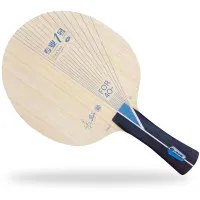
Matchup Overview & Context
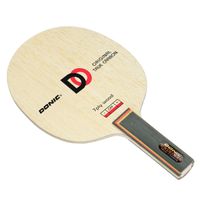
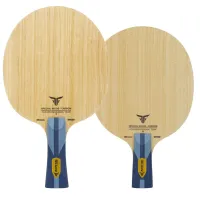
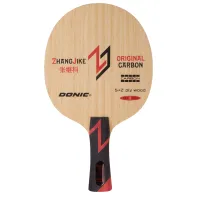
The Donic Original True Carbon and the Loki Telson Speed both represent the popular outer-composite blueprint popularized by legendary offensive blades like the Butterfly Viscaria. The Donic Original True Carbon positions itself as an affordable, high-performance alternative for offensive loopers, retailing at roughly ~€108. The Loki Telson Speed similarly adopts an outer-composition carbon layout aimed at modern aggressive attackers. Players frequently compare these alternatives to establish whether budget-tier composite options can match the mechanical consistency and playability of premium market leaders.
Weight & Bounce Frequency
The Donic Original True Carbon carries a manufacturer-stated weight of 90 grams and features a substantial 6.2 mm thickness. Its 7-ply construction utilizes a layered approach with Koto outer plies, Kevlar carbon inner-surface layers, Ayous intermediate plies, and a Kiri core. Real-world feedback indicates a solid, balanced weight distribution in the hand despite a slightly smaller handle profile.
Speed, Feel & Dwell Time
Reviewers draw frequent parallels to the Viscaria template, noting that the Donic Original True Carbon delivers high-end offensive speed with a surprisingly forgiving touch. While some players perceive the Donic blade as slightly faster and crisper than the Viscaria baseline, others report a softer overall feedback upon ball impact. The dwell time is moderately extended for an outer-carbon blade, allowing for secure rotation generation during topspin play without sacrificing the direct power transfer required for fast rallies.
Stroke-by-Stroke Consensus
Short Game & Touch: The blade provides a reliable, predictable platform for short pushes and service returns, though the reactive outer carbon demands a steady hand to avoid popping the ball up.
Looping & Topspin: Highly suited for modern offensive topspin play, enabling crisp opening loops with a reliable arc and strong acceleration when driven by proper technique.
Blocking & Smashing: Exceptional stability during active blocks and flat kills, absorbing incoming power well while redirecting energy efficiently.
Counter-Play & Mid-Distance: Offers solid stability away from the table, maintaining trajectory and depth during counter-looping rallies.
Recommended Rubber Pairings
To maximize the offensive potential of the Donic Original True Carbon, medium-hard to hard spin-elastic tensors pair exceptionally well by utilizing the blade's carbon snap for increased rotation. Alternatively, players preferring tacky, hard-sponge Chinese rubbers will benefit from the blade's inner Kiri and Ayous core flexibility, which helps compensate for the lower natural elasticity of tacky sheets during mid-distance rallies.
Target Player & Playstyle
This matchup suits intermediate to advanced offensive players who employ a modern loop-drive style close to the table and from mid-distance. It rewards players with sound footwork and accelerated swing mechanics who desire professional-level carbon performance without paying premium brand prices.
Verdict & Buying Guidance
Donic Original True Carbon Pros:
- Excellent cost-to-performance ratio compared to flagship alternatives
- High offensive ceiling with a forgiving, slightly softer feel
- Very balanced mechanical behavior across all offensive strokes
Donic Original True Carbon Cons:
- Handle dimensions are noticeably smaller, which may not suit players with larger hands
- Demands consistent technique to control the high speed
Loki Telson Speed Pros:
- Utilizes a proven outer-composite architectural layout
- Tailored specifically for modern aggressive attack styles
Loki Telson Speed Cons:
- Limited community data and availability outside specialized markets
- Consistency across individual samples can vary compared to established European brands
Choose the Donic Original True Carbon if you want a reliable, Viscaria-style outer carbon blade with proven community backing and a more accessible price point.
Choose the Loki Telson Speed if you prefer exploring niche alternative manufacturers that experiment with standard offensive carbon blueprints.