DHS Gold Arc 9
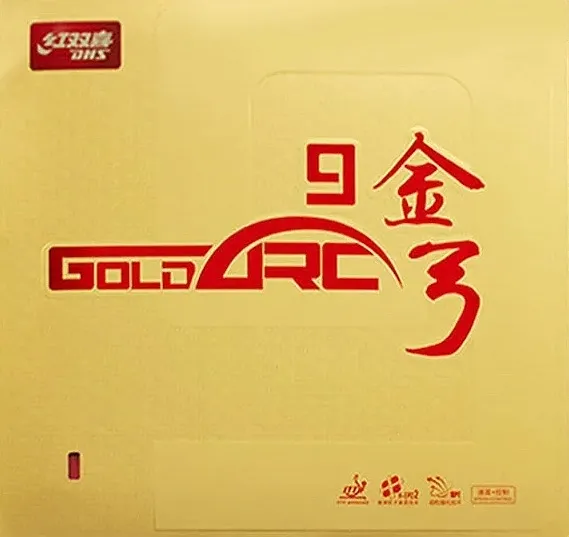
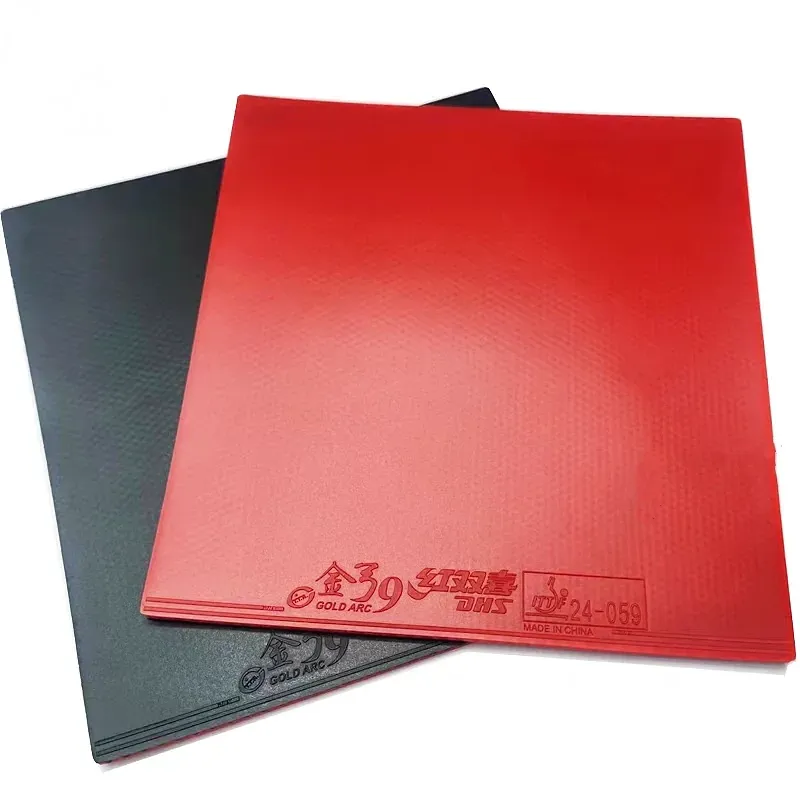
Rubber description
This is a tensor rubber characterized by an elastic, thin topsheet paired with a Japanese-style sponge. While it lacks the aggressive catapult effect found in some modern high-tension counterparts, it provides a stable and reliable performance profile with a medium-high throw angle. The rubber requires a brief “playing-in” period to reach its full potential, after which it offers consistent characteristics across various offensive and defensive strokes.
Playing Characteristics
- Spin and Speed: The rubber generates good spin and offers respectable speed, particularly when looping. While it performs well in flat hitting and smashes, it requires an active stroke to generate maximum pace, as it does not possess an inherent explosive catapult effect.
- Control and Dwell Time: A key feature is the significant ball dwell time, which assists in placement accuracy and service reception. The sponge acts as an energy absorber, making it highly controllable and forgiving during block and touch shots.
- Sponge Options: Available in 37 and 38-degree hardness versions, providing a choice between a softer, more control-oriented feel and a slightly firmer option that offers increased speed. The rubber performs consistently across different blade types, generally maintaining a balanced arc that facilitates backhand play and loop-based attacks.
Also Known As
- Chinese: 金弓9 (slang: 金弓)
- Japanese: ゴールデンアーク9
Submit a Review
Recent Reviews
#1 — August 2026
UPDATED! After being pleasantly surprised by the GoldArc 9 (38-degree sponge, 2.1 mm), I’ve now bought one with a 37-degree sponge and 2 mm thickness. Weight in original packaging: 108 g. Uncut: 65 g. I’m really curious to see how it compares to the firmer version, and I’ll report back soon! ; -P After playing the Gold Arc 5 (with 47.5 degree sponge in max.) for a season a few years ago, I was very excited about the new GA 9. I’m testing this rubber (… once again, first) on my Huieson ZLC outer, on my FH (… together with the Xiom Vega Hybrid, both glued with solvent-based glue). Facts: black rubber in 38 degree version with 2.1 mm sponge. Weight in original packaging 112 g, sealed 79 g and uncut 76 g. On my blade, the final result is a pleasant, medium weight of 48 g (157×150 mm). For years “a” GA 5 has been made in Germany and plays almost like a mixture of Tensor and China rubber; P and now there’s the GA 9, made in China, which plays almost like a Tensor!!! — funny. : -D From the very first hits, it is immediately apparent that the GA 9 is much softer/more elastic and catapults better than the GA 5 (with 47.5 degrees at max.). The speed and rotation level of both seem to be roughly identical. What I definitely like about both rubbers is that they both react very little to incoming rotation and play in a very controlled manner. Unfortunately, I am currently unable to directly compare the 37-degree and 38-degree versions of the GA 9; consequently, I have not made any entries in the table for them. However, the fact remains that these highly catapult-like rubbers deliver impressive speed, which results in a slight loss of control. Bottom line: I, too, currently think that this rubber comes very close to Tenergy 05—except that it isn’t spin-sensitive!!!
#2 — October 2025
Product fine, customer service perfect.
#3 — October 2025
Very similar to Bttfly T05 but much longer lifetime. Medium low throw angle just perfect to hit end of the table. I use it on backhand (37 degrees) and I am very satisfied with it.
Get Notified of New Equipment and Reviews
༼ つ ◕_◕ ༽つ No spam or other useless stuff. We plan to send out some newsletters from time to time with the latest reviews and project updates. Feel free to unsubscribe at any time.